Welcome to Steinbot!
New preface for Steinbot v1.1:
Steinbot is a tool for phraseological inquiry and word-to-word level analysis of the esteemed poet Gertrude Stein. Steinbot was initially developed in Fall 2025 as a final project in a graduate seminar on women poets of the Modernist movement. But even as it neared completion, the potential for expansion became alluring. At that time, Steinbot only contained a corpus of Gertrude Stein’s book Tender Buttons. Now, it contains selections from over 100 poems across her ~50 year publication history, including some posthumous work.
As with many endeavors in digital humanities, this project has to contend with the Goliath of ChatGPT and other large language models (LLMs). One might ask if there’s anything here that ChatGPT couldn’t do faster and better. The apparent answer is yes.
Because LLMs are trained on a massive amount of language from across the internet, they inherently reflect a normativity of syntax that makes a poet like Stein incredibly difficult to analyze and pantomime. In a Stein poem, the syntactic leaps and word classes are intentionally arcane. Even if ChatGPT can create a Steinian poem, it does so through a process of heuristic decision making. It relies on consensus of concepts. Steinbot, however, is much smaller in its function, and utilizes good ol’ algorithmic computation. It can only respond to the specific pool of data and reflect the exact word-to-word relationships relevant to the corpora.
If ChatGPT is a McLaren F1, Steinbot is a Vespa. The amount of power in a tool like an LLM is impressive, but it does best in straightaways and open spaces. It’s poorly suited to the labyrinthian alleys and sidestreets of poetry. In particular, the syntactic layout of the Modernist poets are best traversed by a smaller, nimbler, and more tailored vehicle. This is our defense of local language modeling, trained toward specific goals, without the entirety of Reddit tossing their syntax in the ring. Steinbot is an argument for specialization in an era of generalists.
It's easy to imagine that the illustrious work of Gertrude Stein is something close to goobledygook. With poems that feel unstructured, nonsensical, and often frustrating, she's high on the list of difficult poets. But if her work were truly nonsensical, it would entirely resist analysis or replication. Within this corpus and its internal text generation, we see patterned word-to-word likelihoods, maintained themes, and even occasional surviving puns.
Why does this matter? Because it shows us that Stein's work, while unorthodox, is not in relationship with randomness.
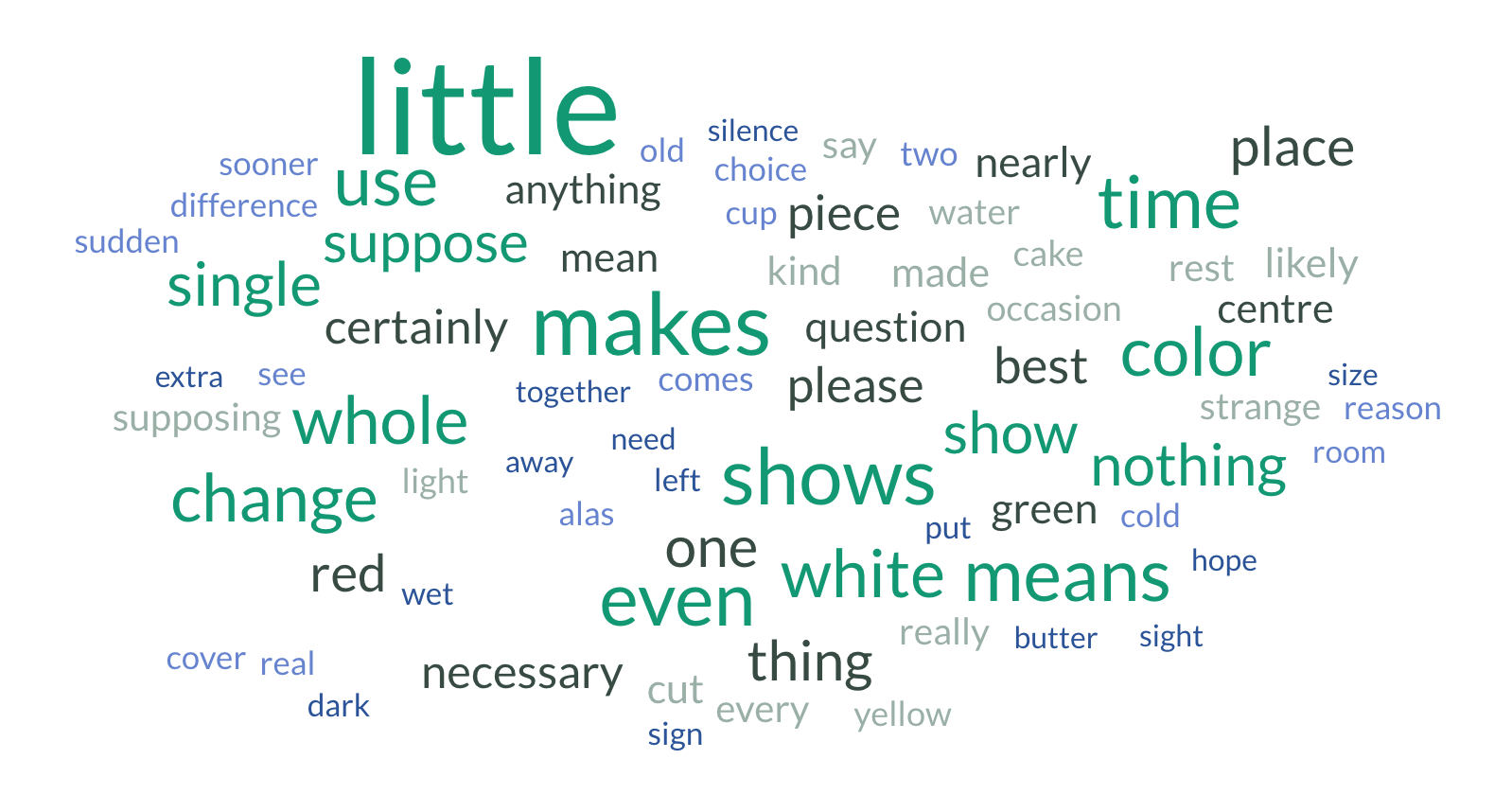
Compare the following randomly generated text to the poem A PIECE OF COFFEE:
Random: "In alteration insipidity impression by travelling reasonable up motionless. Of regard warmth by unable sudden garden ladies. No kept hung am size spot no. Likewise led and dissuade rejoiced welcomed husbands boy. Do listening on he suspected resembled. Water would still if to. Position boy required law moderate was may."
Stein: "A single image is not splendor. Dirty is yellow. A sign of more in not mentioned. A piece of coffee is not a detainer. The resemblance to yellow is dirtier and distincter. The clean mixture is whiter and not coal color, never more coal color than altogether."
We can see that Stein is still in relationship with lived experience. The conditions of the modernists were those of a rapidly changing global and informational landscape. The world was still traumatized by the collision of industrial technology and warfare. Stein's body of work asks us how the technology of language and poetry respond to similar impacts and collective traumatization. A question we are unfortunately still required to ask today.
If we imagine that poetry which obeys more formal and antique constructions is somehow inherently imbued with luminous primacy, we also start to indebt the past with salvational responsibilities: Atlantis, Arcadia, Eden, etc. Many have gone backwards in an effort to Make Language Great Again, but return carrying only the angst of a fantasy unrealized. From such an endeavor, there are three options:
1. We can look for someone to blame.
2. We can maintain our false idols.
Or,
3. We can set the past down compassionately, rummage through its pockets, and move into the world as it is, taking up the task of writing that belongs to the here and now.
This, at risk of misrepresentation, is the task that Stein takes up 100 years ago. By shedding our allegiances to an unretrievable past, we can read Stein and other Modernists as something other the ruinous collateral of a bygone era. Not as how language has decayed, but how it has survived.
•
We invite you to click through the site and explore a newer intersection of technologies, poetry and programming. As you do, we hope you'll delight in the fun of text generation, the survival of Stein's voice, and the play that enervates even the most serious of poetry.
Thank you,
Joplin and Lewis
How poem generation works
Under the hood, this app uses Markov chains with a basic probability distribution to determine the next most-likely word.
For instance, say the word "four" appears in Ms. Stein's work three times before the word "choices" appears, and twice before "are." In that case, the poem generator will write "four choices" 60% of the time and "four are" the other 40%. This process repeats until the poem's maximum length is reached. (NB: selecting the "Invert probability" checkbox in the togglable controls will prefectly reverse this relationship.)
Surprisingly, although there is no logic in the software that disincentivizes language loops (e.g. "a rose is a rose is a rose is a rose"), these loops rarely occurred in our testing.
Future versions of Steinbot will include a greater corpus and allow users to select specific texts to tailor the text-generation model on the fly. In theory, this app could be used for any collection of texts, or for any author. Future versions may even allow users to upload their own texts and generate poems from bespoke corpora. Dare to dream!
Our team